
Two RareBoost Researchers Awarded TÜSEB R&D Support Grants
We are proud to announce that two researchers affiliated with the RareBoost project have been awarded funding through the Health Institutes of Türkiye (TÜSEB) R&D Support Programs for graduate students. These grants recognize innovative research projects with the potential to advance the diagnosis and treatment of rare diseases.
Defining a Novel Glycogen Storage Disease Associated with PHKG1
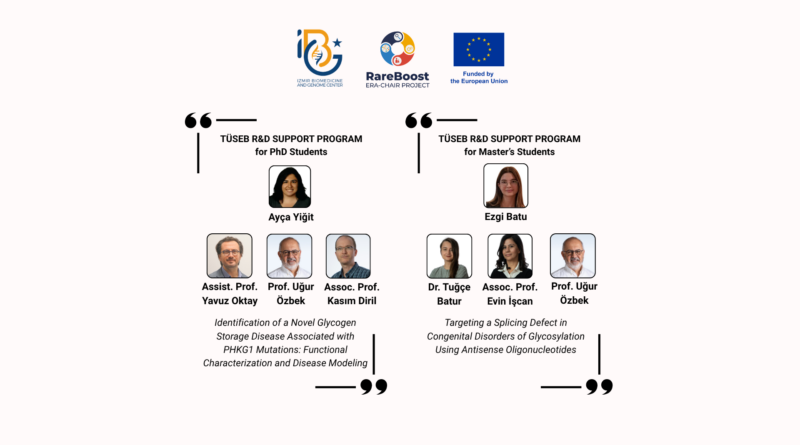
Ayça Yiğit, MSc, a PhD student in the Özbek Lab, has been awarded funding under the TÜSEB R&D Support Program for PhD Students for her project, “Identification of a Novel Glycogen Storage Disease Associated with PHKG1 Mutations: Functional Characterization and Disease Modeling.” The project will be supervised by Prof. Uğur Özbek and conducted in collaboration with co-investigators Assist. Prof. Yavuz Oktay and Assoc. Prof. Kasım Diril, members of the Rare and Undiagnosed Diseases Program (RUDiP) at IBG.
The study builds on findings from the RareBoost project, where whole genome sequencing identified a previously unreported PHKG1 variant in a pediatric patient presenting with clinical features consistent with a glycogen storage disorder. Through the generation of CRISPR/Cas9-based mouse models, the project aims to investigate the functional impact of the variant and establish PHKG1 as a novel disease-associated gene. The findings are expected to improve diagnostic capabilities for glycogen storage diseases and provide a valuable preclinical platform for future therapeutic development.
Targeting a Splicing Defect in Congenital Disorders of Glycosylation
Ezgi Batu, a master’s student in the Özbek Lab, has been awarded funding under the TÜSEB R&D Support Program for Master’s Students for her project, “Targeting a Splicing Defect in Congenital Disorders of Glycosylation Using Antisense Oligonucleotides.” The project is supervised by co-investigators Prof. Uğur Özbek, Associate Professor Dr. Evin İşcan, and Dr. Tuğçe Batur.
The research focuses on a unique splicing defect identified in a patient with PGM1-CDG, a rare congenital disorder of glycosylation. Using an antisense oligonucleotide (ASO)-based splice-switching approach, the project aims to correct the defective splicing event, restore normal PGM1 transcripts, and evaluate the resulting effects on enzyme activity and cellular function. The study has the potential to advance personalized, variant-specific therapeutic strategies for rare genetic diseases.
We congratulate Ayça Yiğit, Ezgi Batu, and their research teams on this important success and wish them every success in their projects.