
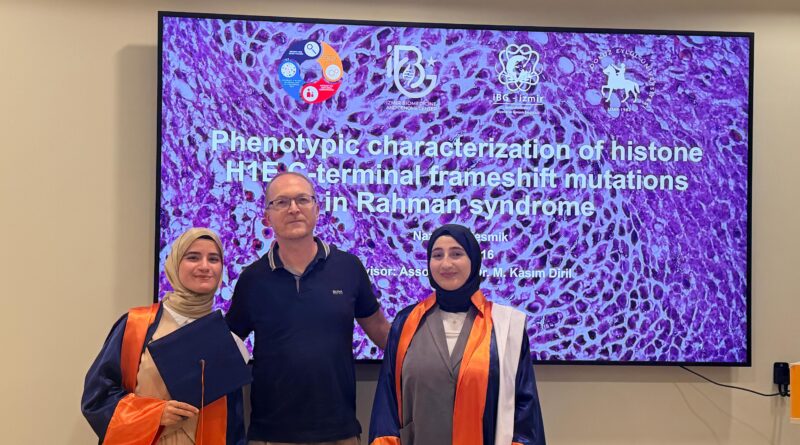
Celebrating Success in Rare Disease Research: Two MSc Students Graduate from IBG’s Diril Lab under the RareBoost Project
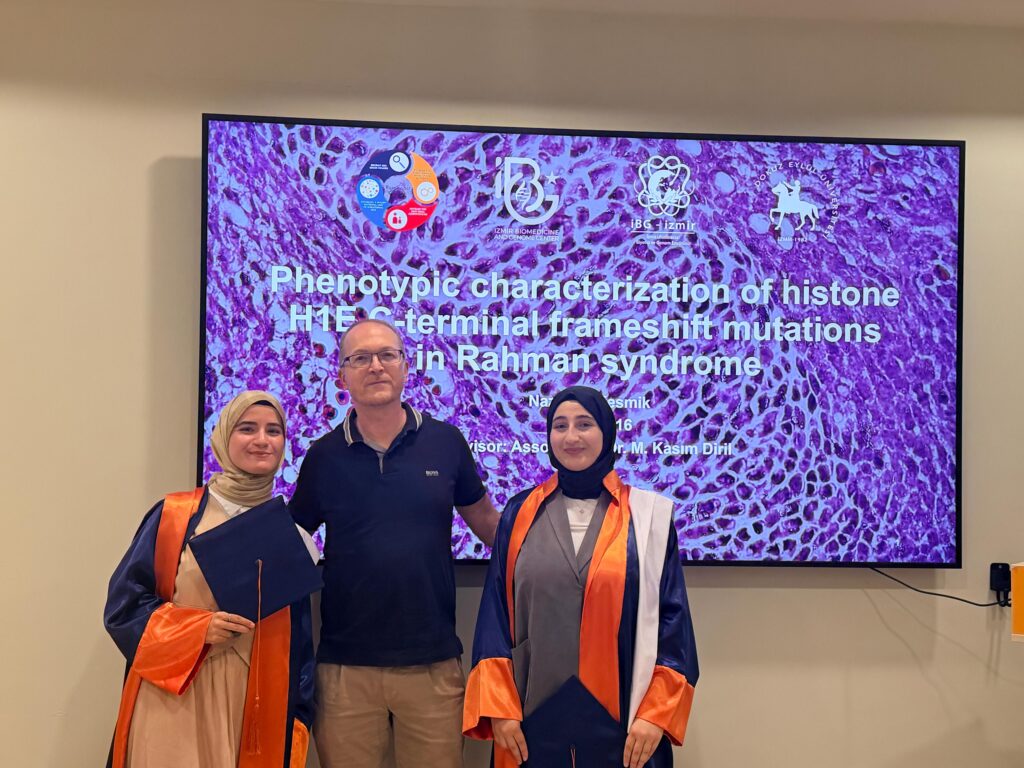
We are proud to announce the successful thesis defenses of two exceptional Master of Science students from the laboratory of Assoc. Prof. Kasım Diril. Both students are members of IBG’s Rare and Undiagnosed Diseases Platform (RUDiP).
Dr. Diril’s laboratory utilizes cutting-edge CRISPR/Cas9 gene-editing technology to develop Genetically Engineered Mouse Models (GEMMs). By introducing specific human disease mutations into these models, the research team can closely observe and characterize the biological and physical effects (phenotypes) of these disorders. This vital work bridges the gap between genetic discoveries and the development of potential future therapies.
The two Master’s projects received crucial support from the EU-funded RareBoost Project, alongside major national funding from TÜBİTAK and TÜSEB. Here is a closer look at the groundbreaking research completed by the two graduates, explained in layman’s terms:
Unlocking the Baseline Mysteries of the ATG9B Gene
Graduate: Ayşe Miray Oto
Thesis Title: Investigation of ATG9B Functions by Genetically Engineered Mouse Models
Ayşe Miray Oto’s research focused on a specific gene called ATG9B, which has recently been linked to a rare neurodevelopmental disease in humans. Under normal, stress-free conditions, this gene naturally stays quiet and produces very low amounts of protein, making it difficult to study. To figure out what it actually does in a living organism, Ayşe used CRISPR technology to create two new mouse models: one completely lacking the gene (a knockout) and another that “tags” the protein so it can be tracked.
Surprisingly, her study revealed that mice without this gene develop, grow, and reproduce perfectly normally under baseline conditions, showing no spontaneous organ or tissue damage. Her findings suggest that the body’s natural cellular quality control mechanisms quickly clean up the faulty genetic instructions before they can cause harm. This crucial baseline study proves that while ATG9B isn’t required for everyday survival, these new mouse models are now perfectly primed for future research to see how the gene behaves when the body faces stress or disease.
Modeling the Neurological Impacts of Rahman Syndrome
Graduate: Nazlıcan Kesmik
Thesis Title: Phenotypic Characterization of Histone H1E C-Terminal Frameshift Mutations in Rahman Syndrome
Nazlıcan Kesmik focused her thesis on Rahman Syndrome (RMNS), a rare neurodevelopmental disorder that causes overgrowth and intellectual disabilities in patients. The disease is triggered by a specific mutation in H1E gene that helps package and organize DNA inside our cells. To study this, Nazlıcan analyzed a specialized “knock-in” mouse model that precisely mirrors the human genetic mutation.
Her comprehensive study yielded major insights: while mice carrying two copies of the mutation did not survive past birth, mice carrying a single mutated copy (exactly like human patients) were healthy into adulthood but showed fascinating changes. They exhibited elevated white blood cell counts—hinting at an altered immune system—and distinct behavioral shifts, including lower anxiety levels, reduced movement, and specific memory impairments. By proving that the mutant protein successfully makes its way into the brain and heart tissues and alters gene expression, Nazlıcan’s work provides the scientific community with a highly accurate, robust living platform to finally study how this syndrome changes brain chemistry and behavior.
The successful graduation of Ayşe Miray Oto and Nazlıcan Kesmik marks another step forward for IBG, RUDIP, and the Rareboost project in their shared mission to advance global rare disease research and train the next generation of scientific leaders. Congratulations to our graduates and the entire Diril Laboratory team!